![]() |
Information, translation, everything which can make students appreciate literature more.
domenica 19 dicembre 2010
domenica 12 dicembre 2010
Evalutation info about oral presentation
Oral Presentation Evaluation Form
Name ________________________ Date _______
Class ____________________________________
Content: if there is enough material to show your ideas and if your ideas are well supported.
Coherence and Organization: if the material is presented in an organized and logical way with a good number of examples.
Creativity: if you are original or repetitive
Material: if you use material, it must balanced (as regards multimedia and paper)
Speaking Skills: if you can speak loudly, clearly and with good intonation.
Audience Response: how your mates react if you can keep them interested.
Length of Presentation: if you use all the allotted time (5') or less or more of it.
COMMENTS:
Exceptional corresponds to 10
Admirable corresponds to 8
Acceptable corresponds to 6
Amateur corresponds to 4
Name ________________________ Date _______
Class ____________________________________
Content: if there is enough material to show your ideas and if your ideas are well supported.
Coherence and Organization: if the material is presented in an organized and logical way with a good number of examples.
Creativity: if you are original or repetitive
Material: if you use material, it must balanced (as regards multimedia and paper)
Speaking Skills: if you can speak loudly, clearly and with good intonation.
Audience Response: how your mates react if you can keep them interested.
Length of Presentation: if you use all the allotted time (5') or less or more of it.
COMMENTS:
Exceptional corresponds to 10
Admirable corresponds to 8
Acceptable corresponds to 6
Amateur corresponds to 4
martedì 30 novembre 2010
Images of the Great Fire of London
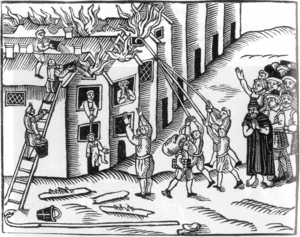
"Firehooks" used to fight a fire at Tiverton in Devon, England, 1612.
Ludgate in flames, with St.Paul's Cathedral in the distance (square tower without the spire) now catching flames. Oil painting by anonymous artist, ca. 1670.
Images of the Great Fire of London
"It made me weep to see it." Samuel Pepys (1633–1703) painted by John Hayls in 1666, the year of the Great Fire.
giovedì 11 novembre 2010
The Agricultural Revolution
There were three main developments during this Agricultural Revolution: the introduction of the four field system by Viscount Townshend ("Turnip" Townshend), the invention of the Seed Drill by Jethro Tull and the selective breeding of animals by Robert Bakewell.
Four Year Crop Rotation
From medieval times, peasants had used a system of three year strip rotation of crops. The peasants worked land which had been granted to them by a landowner, often a nobleman.
Between the 15th and 18th centuries there was a gradual increase in the amount of land being enclosed. Enclosed literally meant that a field was surrounded by a fence or a hedge. It also meant that the enclosed field was worked as a complete unit and no longer divided into strips. The reasons for the increase in land enclosure were varied. Soon after the Wars of the Roses (1455-1485), some noblemen sold their land because they were short of money. Later, during the reign of Henry VIII (1509-1547), monastery land was taken by the king and sold. Traditionally, wool and woollen products had always been England's major export to Europe. As the profit made from the wool trade increased in the 15th century, more land was enclosed to graze sheep. In the 17th century, it was partly new farming techniques which forced land enclosure. When fodder crops, such as turnips, were grown in the open field system, communal grazing would benefit other people's livestock. Between 1700 and 1845, 600000 acres (2,4 million hectares) of land was enclosed in England.
The new landlords, either noblemen or the new landed gentry, turned the peasants off their land. This left many people homeless and with no means of making a living. Most were forced to beg in order to survive. The landowners, however, could now farm entire, enclosed fields.
The gradual enclosure of land, together with the four year rotation system, had two major effects on agriculture. The first was that the harvest increased in yield. In 1705, England exported 11,5 million quarters of wheat. By 1765, wheat export had risen to 95 million quarters. The second effect was that livestock, which no longer needed to be slaughtered before the winter months, increased in both quantity and quality.
The Importance of the Agricultural Revolution to the Industrial Revolution
Crop yield increased
- Enough food was available for people in the cities
- Falling food prices meant more money to spend on consumer goods
- Healthier population which meant decline in death rate, especially in infants
- In the 18th century, the population doubled from 5 million to 10 million
Wool yield increased due to better care of animals and selective breeding
- More wool was available for the textile industry and at less cost
Ready workforce available
- Peasants were turned off their land by enclosures
- Families moved into the cities
- There was much unemployment and many people were looking for work
- Labour was cheap
Add the mindmap of the Agricultural Revolution to the one created for the Industrial Revolution.
Working conditions
Working Conditions
As the coal industry expanded, more and more miners went underground to extract coal and often worked very long hours in hazardous conditions.In 1842 a Parliamentary Committee which reported on the mines found that many workers were working in the most appalling conditions. Not only did they work very long hours, but they were also hired at very young ages. Children as young as five were used as ‘trappers’ to open and close underground doors in the mine to let the ‘hurriers’, who pulled the loaded wagons, get through. These children worked in the dark because their families were often too poor to be able to afford candles. They were in the dark for up to twelve hours each day and often had rats scurrying all over them. If they fell asleep they were beaten by the miners.
The commission also found that children were employed as coal ‘hurriers’, pulling carts or sledges filled with coal over long distances and through very small tunnels. Girls as young as thirteen were often used fir this work. The chain around their waist caused damage to their pelvic bones, distorting them and making them smaller. This often proved fatal in later life when many of them died in childbirth.
The commission discovered that men, women, boys and girls were working together in the most frightening circumstances. Strangely enough, it was the fact that girls were mixed with ‘near naked’ men which caused the most upset, and not the long hours or the harsh and brutal conditions.
Other commissions, such as the Factories Inquiry Commission of 1833, gathered evidence and reported that the situation in factories was just as awful. The factory inspectors found that children worked twelve hour days, generally with only a one hour break. If the factory or mill was busy, they might work up to eighteen hours a day. The conditions were every bit as bad as in the mines, and some reports told of children spending their entire working lives doubled up under machinery in cotton mills. They were often permanently disabled as a result.
The combination of public outrage, political pressure and changes in the law eventually led to better and safer working conditions.
By the end of the 19th century, conditions had greatly improved. However, this was not achieved without pressure from the workers themselves, who increasingly gathered to protest about their conditions of work. These gatherings eventually led to organised self-help groups which later became known as Trade Unions.
Urban Conditions
Blast furnaces light the iron making town of Coalbrookdale
As the new towns and cities rapidly developed during the Industrial Revolution the need for cheap housing, near the factories, increased. Whilst there were some men, such as Robert Owen, who were willing to create good housing for their workers, many employers were not. These employers ruthlessly exploited their workers by erecting poor, and often unsanitary, shoddily built houses. Workers often paid high rents for, at best, sub-standard housing.
In the rush to build houses, many were constructed too quickly in terraced rows. Some of these houses had just a small yard at the rear where an outside toilet was placed. Others were ‘back to back’ with communal toilets. Almost as soon as they were occupied, many of these houses became slums. Most of the poorest people lived in overcrowded and inadequate housing, and some of these people lived in cellars. It has been recorded that, in one instance, 17 people from different families lived in an area of 5 metres by 4 metres.
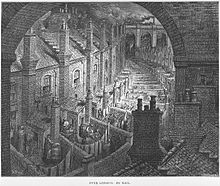
Over London by Rail Gustave Doré c. 1870. Shows the densely populated and polluted environments created in the new industrial cities
Sanitary arrangements were often non-existent, and many toilets were of the ‘earth closet’ variety. These were found outside the houses, as far away as possible because of the smell. Usually they were emptied by the ‘soil men’ at night. These men took the solid human waste away. However, in poorer districts, the solid waste was just heaped in a large pile close to the houses. The liquid from the toilets and the waste heaps seeped down into the earth and contaminated the water supplies. These liquids carried disease-causing germs into the water. The most frightening disease of all was cholera.
- Create a mindmap which summarizes the problems of the Industrial Revolution in Britain.
Etichette:
industrial revolution,
working conditions
Iscriviti a:
Post (Atom)